Archive | Writing RSS feed for this section

In a Relationship

19 Apr

In real life, relationships are complex. In fact, human interaction of any sort is just about the most elaborate intermingling of social, psychological, and physical frameworks you’ll ever see. This is why successful movies, books, and television shows all focus on character growth and personal relationships; people love to see the intricacies at work.

However, these relationships can be molded, contorted into being what we want and, more often, what we don’t want. Through textual mediums such as instant messenger or e-mail, the lack of vocal inflection requires you to be much more deliberate in your diction and phrasing lest you offend someone. Over the phone, facial expressions and hand gestures are lost as your intent is filtered through the wire, requiring your interjecting sighs and chortles to communicate what your physical being cannot.

Take, for (a relevant) example, Call of Duty’s multiplayer voice chat. Without a face to put to the voice, the entire framework of communication laid out by the game effectively forces you to dehumanize your opponents and teammates. To you, they are just a bucket in which you can dump your frustrations, angers, and occasional bits of jubilation. The problem is that this bucket can talk back. It can volley back retorts, obscenities, and racial slurs with the best buckets out there. The rote, mindless action of the game is wholly engrossing, leaving minimal mental faculties for maintaining human decency. This is how you end up with shouting matches and rage quits.

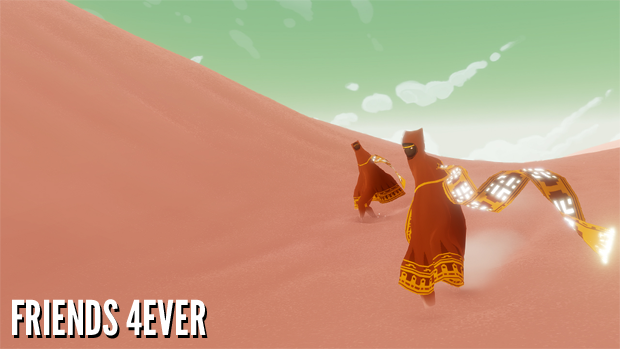
Which makes Thatgamecompany’s Journey’s co-op interactions altogether fascinating. Everything is carefully crafted and placed to the sandy micrometer so as to form intensely personal relationships with what are ostensibly strangers and does so by forming a single, unique combination of two types of players. Although these numbers convey a sense of simplicity, the dependence on one another is as complex as you can find outside of the game’s rutilant sun.

At the most base interpretation of this affair, one person is a follower and the other is a leader (there is the chance that both parties mutually disengage from this enterprise, but that just makes them both a bad leader and a bad follower). Distilling it to such a rudimentary chemical reaction, though, is doing it a disservice. It is symbiotic necessity for mere existence.

As a leader, you must be brave and resolute. You must never falter or doubt yourself; your follower depends on you. You may not know where you are going or what you are doing, but you move ever forward; your follower has placed his trust in you. You can never quit; your follower believes in you.

As a leader, you are the lance that can pierce the unknown. Your intrepidness is the stalwart beam coming from the lighthouse leading you home. You are not a leader because you chose to be but because it was required of you. Without you, your partner is lost, sad, and alone. You have saved him from the gutter and placed him in your warm embrace where you can be the guiding light he needs to survive.

As a follower, you are reticent and reliable. You acknowledge your leader’s strength and ferocity but never question your own; you are the foundation upon which this relationship is built. You trust your leader because he trusts you; your leader would be nothing without you. You can never quit; your leader needs you.

As a follower, you are the armor that protects from the unknown. Your unwavering commitment is the boat you two will ride to shore and safety from the dangers of the turbulent sea. You are not a follower because you chose to be but because it was required of you. Without you, your partner is lost, sad, and alone. You walk by his side as the fuel to his fire that you both cannot live without.

Journey reduces multiplayer to one of the most basic types of relationships two people can have, but they’ve rebuilt it into one of the most maddening, heart-wrenching, enigmatic examples of beautiful codependency you’ll ever see. It doesn’t matter if you are the leader or the follower; applying those labels diminishes the significance of your relationship. You are one half of a whole. Without you, this gestalt does not exist.

Every emotion I’ve ever had for a sibling, a friend, a lover, or even a stranger I have felt playing Journey. By finding the bedrock upon which all other relationships are built, the game allows you to fill in the gaps with your own experiences and desires, whether you are aware of it or not. Some of you may be turned off by the blank emotional canvas presented to you where all the brushes are already dipped in affection and fellowship, but perhaps that is because you lack the trust to be a follower or the strength to be a leader. You are not playing your role for yourself. You are playing for this unknown person, this stranger that will become your light in the underground, this stranger that will become your fire on the snowy mountaintops.

This stranger that will become a physical necessity.

Friendship, Fear, and the Great Unknown

9 Apr

I could hear the hollow bellow from above. Even over the unrelenting, roaring wind, I could hear it.

I could see the white-hot gaze just ahead. Even through the snowy, sideways haze, I could see it.

Against it all, I prayed I was safe. I prayed we were safe. “Oh god oh god,” I heard myself mutter over and over again, waiting for the terror to pass, huddled in the shadows of this rocky remnant. I turned to my companion.

But he was gone.

Tracks laid were he once stood. Following with my eye the path he now foolishly plowed, I could see him out in the distance. Darting back and forth between him and the skyward beast, my eyes could only attempt to communicate what my voice could not.

“Hey! Come back! Come back!”

It was pointless. The howling winter gusts swallowed my fevered pleas. But suddenly, the empty stare from above turns aggressive, rutilant. My words disappear. My stomach drops.

I begin to step out into the biting air. “Oh god oh god.” The feral creature begins to screech, leering back, preparing to strike. “Move faster! Faster!” I begin to run, dragging my feet through the knee-high powder. “If I can just reach him…” Unfinished thoughts rattle through my mind, unfinished because the ending unfathomable. Inevitable.

My scarf trails in the pale storm, flapping and twisting in the wind. It marks the path of a fool, a sap. Then, the fiend lurches forward, cutting through the frozen air with a searing, unknowable hate.

He collapses. I reach out.

Closer it comes.

He gives up. I refuse.

Screaming in, faster and faster.

He waits for his end. I touch his arm.

And to think, I didn’t even know his name.


Meeting strangers is like playing pachinko. Each time you meet a new one, you are dropping them into your own game of interpersonal fortune. You watch them, sometimes subconsciously, trickle down the ornate and noisy pegboard, bounding around, clinking and clanking from side to side until they come to a sudden and resolved stop.

Will they fall into your good graces and become a friend? What if they fall off the board completely and a stranger is all they will ever be? Tumbling and turning, they are as curious as you.

It’s awe-inspiring, then, when you come across an occasion where those transients you meet during your endeavors take a straight, unwavering path to a reserved and guarded place within you. They cut through the swath of pins and quickly arrive at somewhere much more intimate.

Such as it is with Journey, the latest release from artsy developers Thatgamecompany, and it is a grand experiment in pure, uncut game design. There are no spoken words, no exposition with which to tell you how to interpret the world around you. The title itself is all the instruction you need.

Everything is designed to move you forward. From the way you ski down the sandy dunes of the desert slopes to how the game has removed any possibility for negative progression, this game is about the journey. Even with the multiplayer, they have eliminated any opportunity to grief.

And I truly believe this game was made for multiplayer. Every conceit and every design minutia is put in place to foster a bond between two strangers. Communicating bolsters your flight; being in close proximity provides a warming heat of golden light; and your meditative transitions are positioned to show you are only one half of this experience.

The choice to prohibit voice and text chat while online is a bold and powerful one. You may not realize it, but just hearing how someone sounds or seeing the words they choose informs you with an immediate and everlasting impression.

Journey, however, lets you fill in the gaps for yourself. With no voice—just a melodic chirp to convey intent—you are free to turn that warble into whatever you desire. Every little peep told me a tale of joy in cooperatively conquering a puzzle or filled me with great despair as we both realize our journey has taken a turn for the worse. There is a gravitas you can create yourself that you could not do so otherwise with text and dialogue.

An intimate and familiar relationship is formed. An unqualified kinship develops universally and immediately. I had become frustrated with my companions, even hated them at points, but never did I want to leave them. Their inability to keep up was endearing, and their need to constantly move ahead before I was ready was misguided (or perhaps misinterpreted) concern for making sure the way was safe for us. The struggles we faced were our own and we would overcome them together.

Journey is altogether and simultaneously the most exhilarating, most terrifying, and most bewildering experience I’ve had in such a long time, and it is a triumph in every sense of the word. There are moments of pure, abject fear that froze me in my seat. There are moments where I felt as free and flowing as a bird on the wind.

There are moments where I knew I was playing something special.

Going Backwards: Looking at Uncharted 3

23 Nov

You wake up on a train. You notice it’s not moving but neither are you. A wave of pain hits you as you try to stand. Looking down, you see blood. A lot of blood.

Your blood.

You can see outside the broken window and see that it is snowing, but something is wrong. You start to come out of your daze and sort out what you’re seeing, but suddenly, a crate and then a barrel come flying by your head toward the back of the train. As they burst through the door, revealing nothing but emptiness below, your seat begins to give way. You scramble for more solid ground, but you know you are in trouble; this train is going down with you in it.

You fall through the car, rattling around like a Plinko ball, and eventually fall through to the railing just beneath the door. You are now dangling from the rear of the train, the very end of the line at the sheer face of the cliff. The mystery of how you got there takes a backseat.

You move, but it hurts. You climb, but it’s slow. You jump, grab, and clamber about, but you are dying. You are dying, and no one is there to watch.

You are watching two men walk down a dark English street. They enter a surprisingly lively pub where there are men drinking, talking, and, by and large, looking like thugs. This is because in almost caricature-like fashion, they are thugs. English thugs in a pub drinking beer, working the thug beat to ensure an underhanded dealing goes in the favor of their employer.

This is entirely new, what you’re seeing, but it’s still very familiar: two finely dressed cohorts are lead surreptitiously by meaner-looking men to a rather dapper and well-spoken gentleman. Apologies, introductions, brass tacks: it’s all above-board in the action adventure heist genre.

In the most dramatic and fore-telling fashion, a double-cross is revealed; the fellow with the tie and the British accent is screwing these two charming fellows out of money, an ostensibly valuable ring, and their well-being. A few quips and now they’re fighting, bar-style.

Every action is game-like, just as every movement is exaggerated and almost comical; bashing a fellow’s head with a cue stick, being dragged facedown across a bar and out a window, and throwing down with three confused but equally hostile foes upon landing are almost to be expected and soon after actually happen.

There is never any real gravitas here. It’s apparent from the outset that these two men, despite one’s advancing age and the other’s cheery disposition, are more than capable of handling themselves against these pawns (and the clichéd brute). For every hit they take, they are ready to deal three more until they make their way to the back alley for their less-than-ideal escape, but not before one last encounter with the bad guy.

Some storied banter leads to two implausible deaths; implausible because these are the leads. For all their trials and labored tasks, they cannot die. Their progress is forever locked in step towards the end of this story.


You are either the hero or the spectator. Uncharted 3: Drake’s Deception took a step backwards from its predecessor and put you back into the role of an intervening viewer. You went from the natural reveal of Uncharted 2: Among Thieves where all your knowledge grew with Nathan’s through the game’s diegesis and the impetus of waking up on the train with a commensurate amount of confusion to simply observing another action fantasy. I’d much rather be the guy who saves the world than watch the guy who does it.

Even if I am dying.